
Cattle feed in Turkey sees growth

درباره سایت
آخرین مطالب
- طعم دهنده های شیمیایی و گیاهی
- هفته جهانی آگاهی از مقاومت ضد میکروبی World Antimicrobial Awareness Week – WAAW
- اثر طعم دهنده ها در خوراک حیوانات خانگی سگ و گربه
- GAA یا GABA
- نسل جدید پروبیوتیک ها NGP در خوراک انسان و حیوانات اهلی و خانگی
- اسید گوانیدینواستیک اسید GAA
- بیوسورفکتانت ها Bio surfactant
- ارزیابی نمره وضعیت بدنی Body Condition Score
- کاربرد گیاه حاوی ترکیبات تانن درجیره گوسفند و اثر آن بر پروفایل اسیدهای چرب، بیوهیدروژناسیون شکمبه و
- آنزیم های Exogenous
امکانات وب
Published on: 8/22/2023
Author/s : K. Pongmanee and D. R. Korver / University of Alberta
Summary
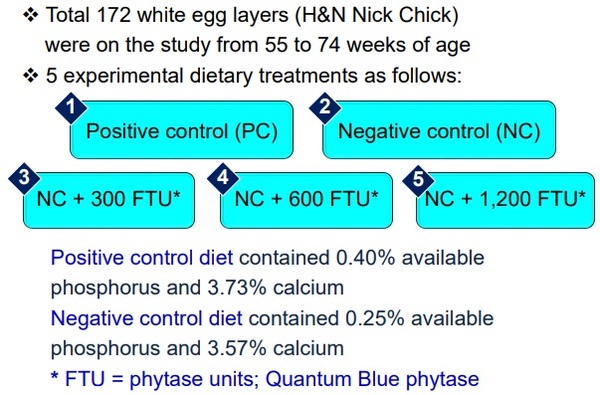
This study was conducted to test the efficacy of phytase in low phosphorus and calcium diets in the late production cycle for maintaining the productivity, eggshell and bone quality of hens fed low phosphorus and calcium.
Problem
Exogenous phytase supplementation has become a standard practice for poultry diets to liberate available phosphorus and reduce excretion of phosphorus in manure. Many studies showed that phytase supplementation increased egg production and egg weight of laying hens. However, research on phytase use in the late laying cycle is limited.
info_outline

Suggested link
The effect of an alternative to synthetic choline on growth response, hepatic gene regulation and adiponectin expression in broilers
Objective
To determine the efficacy of Quantum Blue phytase in layer diets on egg production, eggshell and bone quality in the late laying cycle from 55 to 74 weeks of age in laying hens.
Hypothesis
We hypothesized that egg production, eggshell and bone quality would be decreased in hens fed reduced levels of available phosphorus and calcium (negative control), and that phytase supplementation in the negative control diets would return those parameters to the level of positive control treatment group.
Our Approach
Study parameters:
- Body weight, feed intake, and feed conversion ratio
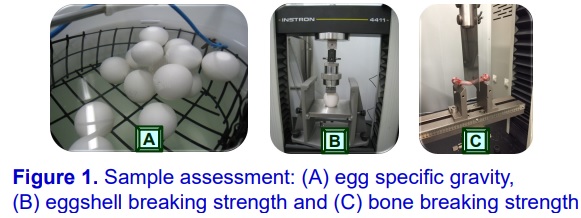
- Egg production, egg weight, egg specific gravity (Figure 1A) and eggshell breaking strength (Figure 1B)
- Bone breaking strength (Figure 1C) and bone ash
Our Observations
At 74 weeks of age:
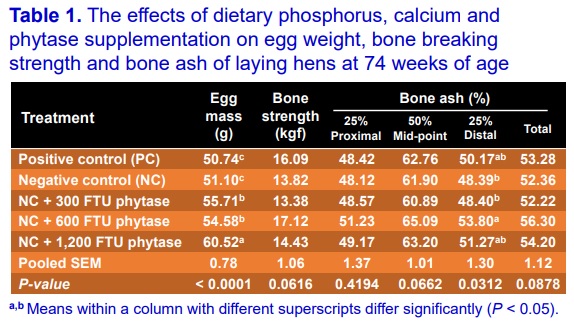
- No significant difference among treatments was observed in body weight, feed intake, feed conversion ratio, egg production, egg specific gravity or eggshell breaking strength.
- Laying hens fed the negative control diet plus 1,200 FTU phytase/kg had the highest egg mass.
- Supplementation of 600 FTU phytase/kg resulted in higher bone ash than the negative control and the negative control plus 300 FTU phytase/kg groups.
What does this mean?
- Modern laying hens seem to be able to deal with low dietary phosphorus and calcium levels.
- Phytase supplementation increases egg mass, and tends to increase bone quality in the long term.
- Further reductions in dietary P and Ca might be possible
نوشته شده توسط محمد ولی تکاسی
| لینک ثابت |
برچسب:
نویسنده: فاطمه زارعی